

A portfolio career is a deliberately built mix of paid roles, projects, and ventures running at the same time, replacing one employer with several income streams that reinforce each other. The payoff for mid-career professionals is real: diversified income, more control over your schedule, and the kind of variety that a single job title rarely delivers. It works best for people with a marketable skill, some savings, and a tolerance for irregular paychecks.
TL;DR:
- Portfolio careers often involve a combination of a reliable anchor role with additional complementary strands that share skills, audiences, or schedules to prevent fragmentation.
- Building a successful portfolio requires honest asset auditing, choosing a main income source, testing new streams before fully committing, and maintaining systemized financial and scheduling practices.
- The most resilient professionals manage a coherent architecture by aligning each strand with their core expertise or audience and rejecting unrelated opportunities that dilute their identity.
- A clear three-step process of reflection, discovery, and action helps turn the idea into a concrete plan with specific tasks, timelines, and financial goals.
- Long-term success relies on aggressive time management, setting revenue targets, proactive relationship maintenance, and managing a small, focused portfolio rather than random gigs.
Table of Contents
- What Is a Portfolio Career (And How Is It Different From a Side Hustle)?
- Who a Portfolio Career Actually Fits
- What Portfolio Careers Actually Look Like
- How to Build a Portfolio Career Step by Step
- Building an Architecture, Not a Pile of Gigs
- Turning Reflection Into a Real Plan
- What Actually Keeps a Portfolio Career Running Long Term
- Get a Clearer Read on Your Own Portfolio Fit
- Sources
What Is a Portfolio Career (And How Is It Different From a Side Hustle)?
The Cambridge Dictionary defines a portfolio career as having a variety of roles instead of one job, with the benefit of greater income and personal fulfillment when it's managed well. That word "managed" is doing a lot of work. A portfolio career isn't a pile of gigs you fell into. It's closer to how the UTS Open insights piece frames it: income from several concurrent roles, paid or voluntary, chosen on purpose rather than out of desperation.
That's the line separating it from a side hustle. A side hustle is usually temporary and peripheral, something you run on nights and weekends until it either dies or replaces your day job. A portfolio career is the main event, and freelancing is often just one strand inside it rather than the whole structure.
Common shapes include:
- Part-time employment paired with independent consulting in the same field
- A fractional executive role combined with teaching, speaking, or advisory work
- A core service business alongside a productized offer, like courses or templates
- Multiple part-time roles across different organizations that together add up to full-time hours
Who a Portfolio Career Actually Fits
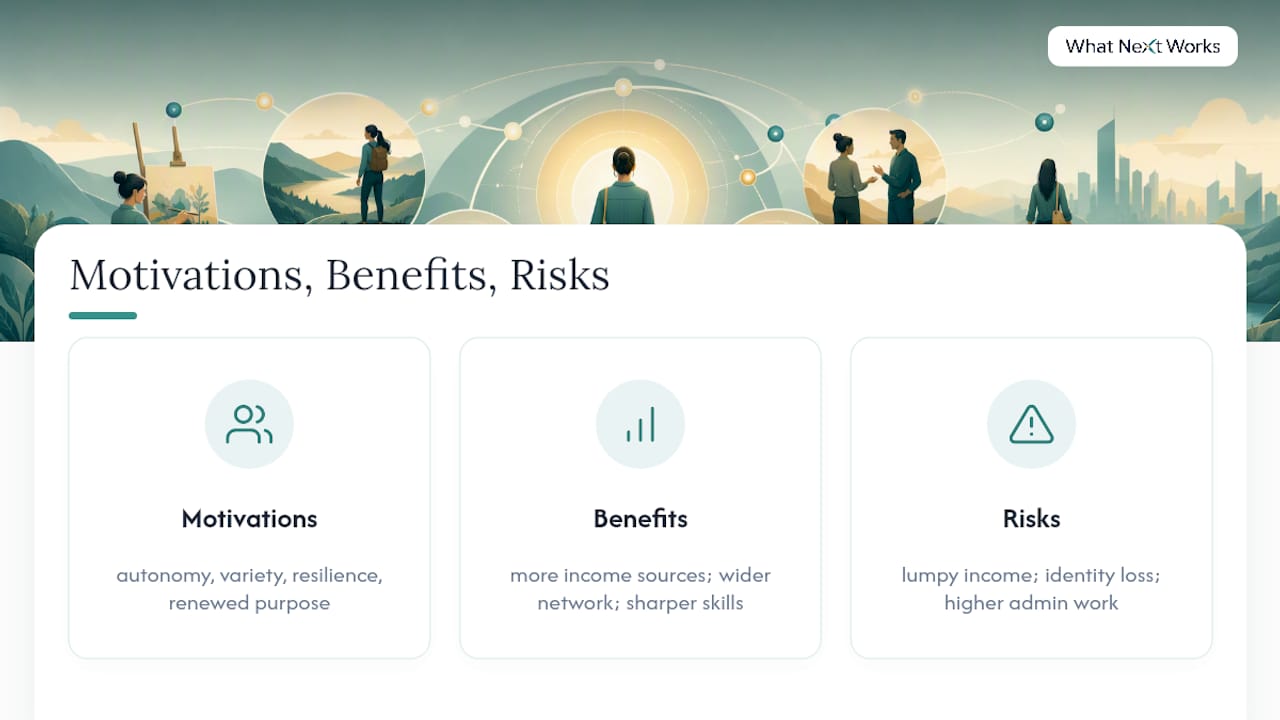
People move toward this model for four reasons: autonomy, variety, resilience, and a sense of purpose that a single job stopped providing somewhere around year eight or ten of a career. If you're bored, boxed in, or nervous about depending on one paycheck, the motivation is usually already there.
The benefits show up fastest in three places: your income sources multiply, your professional network widens because you're now touching more industries and clients, and your skills stay sharp because you're applying them in different contexts instead of one narrow lane.
But the risks deserve equal airtime. Income becomes lumpy instead of steady. Some people struggle with the identity question. "What do you do?" stops having a one-line answer, and that can feel destabilizing before it feels liberating. Administrative overhead also grows fast, since invoicing, contracts, and scheduling now multiply by however many strands you're running.
Multiple jobholding is already common in the U.S. labor market. BLS data on contingent and alternative employment arrangements shows second jobs regularly break down across independent contractor work, on-call arrangements, temp agency placements, and contract firm assignments. Portfolio careers aren't a fringe experiment. They're a more intentional version of something already baked into how Americans work.
What Portfolio Careers Actually Look Like
The shape of a portfolio depends heavily on your industry, your risk tolerance, and how much predictable income you need to sleep at night. Here are compositions that show up often among mid-career professionals:
- Part-time corporate role plus consulting. Someone drops to three days a week at a company and fills the other two with independent consulting in the same domain, often for competitors or adjacent firms.
- Fractional executive plus teaching. A former operations VP takes on two fractional COO clients and teaches a night course at a local university, splitting time roughly 60/40 between execution and instruction.
- Product plus services. A designer sells templates or a course while also taking select client projects, so passive-ish product income cushions the feast-and-famine cycle of client work.
- Multiple part-time employment contracts. Two or three organizations each hire the same person for 15 to 20 hours weekly, common in healthcare, nonprofit leadership, and specialized trades.
- Anchor-heavy model. One role provides a majority share of income and the rest is exploratory, low-stakes work testing whether a new direction has legs.
Choose an anchor-heavy model when you need cash-flow certainty. Choose a balanced mix once you've validated that multiple strands can each pull real revenue.
How to Build a Portfolio Career Step by Step
Building this deliberately beats stumbling into it. Here's a practical sequence.
- Audit your assets honestly. List your marketable skills, your professional reputation (who would refer you work tomorrow?), your savings runway, and hard constraints like caregiving responsibilities or a mortgage that demands stable monthly income.
- Pick your anchor. This is the role or client base that pays your bills most reliably. Everything else gets designed around it, not the other way around.
- Sketch two or three complementary strands. Each one should connect to your anchor through a shared skill, a shared audience, or a compatible schedule. Random unrelated gigs are the number one killer of portfolio careers.
- Market-test before committing. Run a paid pilot project, a short consulting engagement, or a mini-retainer before you build an entire strand around an unproven idea. This is cheap insurance against months of wasted effort.
- Plan your finances with real numbers. Build at least three to six months of runway, map out when each stream actually pays (net 30 contracts hit differently than weekly consulting invoices), and research self-employment tax obligations and health coverage options before you need them, not after.
- Set up systems early. A shared calendar across all your commitments, standard contract templates, a simple client pipeline, and explicit working-hour boundaries save you from the chaos that sinks a lot of first attempts.
- Give yourself a 6 to 12 month runway to transition. Milestone one: validate the anchor. Milestone two, around month three or four: add the first tested strand. Milestone three, around month nine to twelve: reassess the full mix and drop whatever isn't earning its slot.
The Oxford Careers Service workbook offers structured exercises for exactly this kind of mapping, walking through skills, time allocation, and revenue estimates strand by strand.
Pro Tip: Before you add any new strand, ask one question: does this share an audience, a skill, or a schedule with something I already do? If the answer is no to all three, it's probably going to fragment your reputation instead of building it.
Building an Architecture, Not a Pile of Gigs
The difference between a thriving portfolio career and an exhausting one usually comes down to architecture. Practitioner guidance from the Advisory Board Centre frames this well: pick a single "credibility anchor," one role reliable enough to fund your life and reputable enough to open doors for everything else.
From there, map each additional strand against job-type realities. Contract work and temp-agency arrangements carry different onboarding cycles, payment timelines, and paperwork than part-time employment does, and your cash-flow plan needs to reflect that instead of assuming every stream pays on the same schedule.
Alignment rules keep the whole thing coherent:
- Every strand should share an audience, a transferable skill, or a compatible calendar with your anchor
- Reject opportunities that require you to build an entirely new network from scratch
- Standardize your invoicing cadence across strands so you're not tracking five different payment rhythms in your head
The most common trap, according to explainers on the structure of portfolio careers, is collecting unrelated gigs that dilute your professional identity instead of reinforcing it. The fix isn't saying no to everything. It's requiring each yes to meet at least one alignment rule before it earns a spot on your calendar.
Turning Reflection Into a Real Plan
Most people who consider a portfolio career get stuck at the reflection stage, turning the idea over in their head for months without a structured way to move forward. A three-step process, reflection, discovery, action, breaks that gridlock into concrete tasks.
Reflection means an honest self-audit: what skills you actually have, what you value, and what constraints are non-negotiable. Discovery means small, low-risk market tests, a pilot project, an informational interview, a short paid trial, that tell you whether an idea has real demand behind it. Action means a written plan with specific next steps, timelines, and financial targets rather than a vague intention to "figure it out eventually."
If you want to see where you currently stand, the free Career Snapshot gives you a starting read on your readiness before you commit to anything.
What Actually Keeps a Portfolio Career Running Long Term
The professionals who make this work for years, not months, share a few habits. They timebox aggressively, protecting anchor-role hours the same way they'd protect a client meeting. They set explicit revenue targets per strand instead of vague hopes. And they maintain relationships proactively, checking in with past clients and collaborators before they need work, not after the pipeline runs dry.
The mindset shift matters more than any single tactic: you're managing a small portfolio, not juggling random obligations. That distinction changes what you say yes to.
— TK
Get a Clearer Read on Your Own Portfolio Fit
You've read the framework. The harder part is applying it to your own skills, finances, and risk tolerance without guessing. Whatnextworks gives mid-career professionals a structured way to do that instead of staring at a blank page wondering where to start.
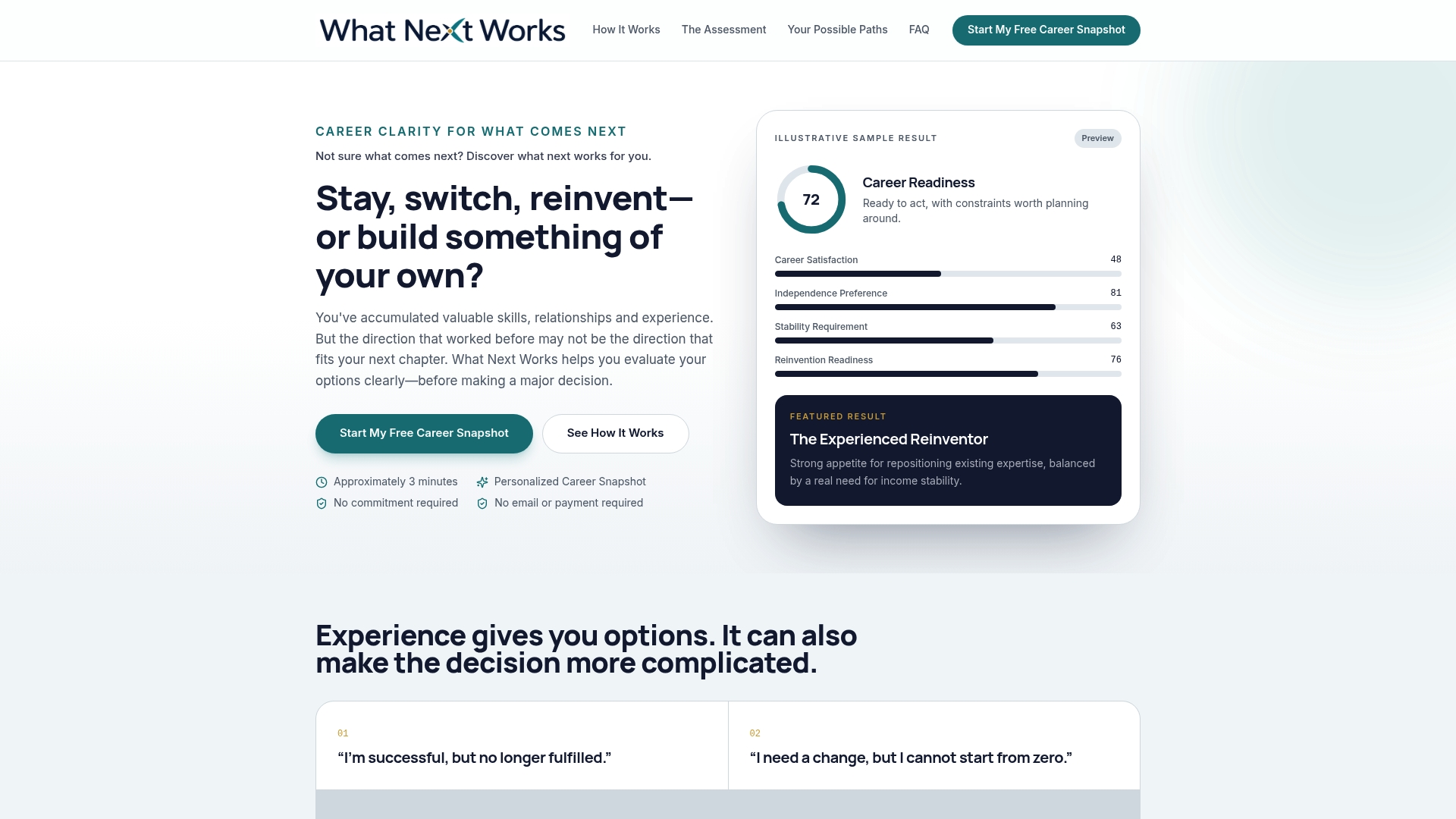
The free Career Snapshot takes a first pass at your readiness for a multi-role setup, no email or payment required. If you want the deeper version, the paid Career Roadmap builds on that snapshot with a full readiness analysis, a satisfaction and independence score breakdown, a role-family comparison, and a direct look at employment versus independent work so you can see which anchor-plus-strand combination actually fits your situation. Visit the deep-dive breakdown to see exactly what the report covers, then run your free snapshot and decide from there whether the full roadmap is worth the one-time $12.99.