
A midlife career change is realistic, and it's already happening for millions of people in their 40s, 50s, and 60s. The single best next move isn't a resume overhaul or a leap of faith. It's a small, focused experiment, a handful of informational interviews plus one measurable side project, that gives you real evidence instead of guesses. Expect the full transition to take several months, often up to a year and a half, with a temporary pay or comfort dip along the way.
TL;DR:
- Conduct at least five informational interviews and start a small side project within the first 30 days to gather concrete evidence about a new career path.
- Expect a pay dip of 15 to 30 percent during transition, but income often recovers within two to three years, especially in high-demand fields.
- Focus on building proof of concept through side projects and real-world testing before investing in extensive training or making a full transition.
- Narrow your exploration to role families rather than specific titles, and have 20 to 30 conversations to validate your target roles.
- Use structured reflection, discovery, and testing phases to create a tangible action plan tailored to your skills, constraints, and goals.
Table of Contents
- Your 30/90/180-Day Action Plan For A Career Change At 40 (Or Any Age)
- Why Midlife Career Changes Are Becoming So Common
- The Step-by-Step Roadmap: Reflection, Discovery, Testing, Training, Transition
- What Will A Career Change Cost You Financially?
- How To Test A New Career Before You Commit To It
- Reframing Identity: The Mental Work Nobody Talks About
- How What Next Works Turns Reflection Into An Actual Plan
- What I've Learned Watching People Get This Wrong (And Right)
- Ready To Find Your Own Next Move?
- Sources
Your 30/90/180-Day Action Plan For A Career Change At 40 (Or Any Age)
You don't need a five-year plan. You need the next 30 days mapped out clearly, because momentum beats perfection every time someone tries to change direction in their career.
Days 1 to 30: Gather intelligence, not applications.
- Schedule 5 informational interviews with people doing work you're curious about.
- Write down 10 transferable skills you already have, and be specific (not "leadership," but "ran a 12-person team through a product launch with zero turnover").
- Draft a one-page brief for a small side project you can start this month, even if it's unpaid.
Days 31 to 120: Build proof of concept.
- Complete one micro-course or certificate relevant to your target field.
- Take on a small piece of contract, freelance, or volunteer work in that direction.
- Track how the work actually feels day to day, not how it sounds at a dinner party.
Days 121 to 180: Sharpen and negotiate.
- Rewrite your resume and LinkedIn profile around the target role, not your old title.
- Pitch a pilot project, part-time arrangement, or contract-to-hire deal with a target employer.
Pro Tip: Track three numbers weekly during your experiment phase: enjoyment (1 to 10), competence growth, and market interest (replies, referrals, inbound questions). If two of three are trending up by week 6, that's your green light.
The Forbes reporting on mid-career transitions makes a blunt point worth repeating here: thinking about a change produces opinions, but only action produces evidence. Most people stall at the reflection stage for years. The 30/90/180 structure exists specifically to prevent that.
Why Midlife Career Changes Are Becoming So Common
Longer working lives are rewriting the math on career reinvention. Stanford's Center on Longevity has documented what researchers now call the "encore" movement, where people in their 40s, 50s, and 60s treat a career pivot not as a crisis but as a rational response to a working life that may stretch into their 70s. When you might work another 25 or 30 years, staying in a role that drains you stops making sense, financially or otherwise, according to the Stanford New Map of Life report.
Automation, burnout, and life disruptions (divorce, illness, a parent's death, a layoff) all accelerate the same reckoning. But midlife brings real advantages that 25-year-olds simply don't have. You've built pattern recognition across a decade or more of decisions, what psychologists call crystallized intelligence, the accumulated judgment that lets you spot a bad deal or a good hire faster than someone earlier in their career. You have a professional network that took 20 years to build. And you likely carry domain knowledge that transfers sideways more easily than you'd expect.
Older entrepreneurs, in particular, show up in the data more often than most people assume. Kauffman's research on senior entrepreneurship documents rising rates of business founding among people over 45, driven partly by savings, partly by networks, and partly by a clearer sense of what they actually want to build.
None of this erases the constraints. A mortgage doesn't care about your sense of purpose. Age bias in hiring is real, even if illegal, and caregiving responsibilities (kids, aging parents, sometimes both) limit how much risk you can absorb at once. The honest framing is this: midlife gives you real leverage, but only if you plan around the constraints instead of pretending they don't exist.
The Step-by-Step Roadmap: Reflection, Discovery, Testing, Training, Transition
Every workable pivot follows roughly the same five phases. The mistake most people make is skipping straight from reflection to transition, no discovery, no testing, and wondering why the new job feels just as wrong as the old one.
1. Reflection: Know what you're actually solving for.
Before you research a single job title, answer three questions honestly:
- What specifically is broken in my current role: the work itself, the people, the pace, the pay, or the purpose?
- What have I built over 15 or 20 years that I'd hate to abandon entirely?
- What financial and family constraints define my actual runway?
Write the answers down. A one-page worksheet listing your top 10 skills, your non-negotiable values, and your hard constraints (income floor, geography, hours) becomes your filter for every decision that follows.
2. Discovery: Research role families, not job titles.
Job titles vary wildly between companies, but role families (the actual work you'd do day to day) are more stable. Map your transferable skills against three or four adjacent role families rather than fixating on one dream job. Then talk to people. Practitioner guidance built around midlife transitions consistently points to 20 to 30 real conversations as the threshold where patterns start emerging, and where a role family that sounded appealing on paper either confirms itself or falls apart.
3. Testing: Build evidence before you build a resume.
This is where most plans die from lack of nerve. Run a one-month side project with a defined deliverable: a mini consulting engagement, a small freelance contract, a volunteer role that mirrors the target work. Shadow someone for a day if you can arrange it. The goal isn't income yet. It's data: does the actual work match the fantasy?
4. Training: Fill gaps efficiently, not exhaustively.
Full graduate programs are rarely necessary and rarely fit a midlife schedule anyway. Micro-credentials, industry certificates, and short bootcamps close most practical gaps in weeks or months rather than years. Target the one or two credentials that unlock interviews, not a stack of certificates nobody asked for.
5. Transition: Negotiate the landing, don't just take the first offer.
If your pivot involves an adjacent move rather than a total reset, you have more negotiating leverage than you think. A fractional or part-time arrangement, or a contract-to-hire pilot, often gets you in the door faster than competing head-on for a full-time role against candidates with a decade of direct experience in the new field.
Pro Tip: An adjacent move, something in the 30 to 40 degree range from your current work rather than a total 180, is consistently the highest-probability path. It preserves your credibility with hiring managers while still opening real new work.
Most well-run pivots land within a timeframe of several months to about a year and a half from first reflection to new paycheck. Expect a J-curve: things often feel worse before they feel better, especially around month four or five when the testing phase reveals gaps you didn't anticipate. That dip is normal, not a signal to quit.
What Will A Career Change Cost You Financially?
Money is where good pivots die from poor planning, not bad ideas. Build your runway before you build your new career.
- Minimum runway: 3 to 6 months of expenses saved before you make any irreversible move.
- Recommended runway for a bigger leap (new industry, new credential, or self-employment): 9 to 18 months.
- Typical pay dip during a transition: 15% to 30% below your prior salary, at least temporarily, particularly if you're moving into an unrelated field.
- Recovery window: income often returns to prior levels or higher within 2 to 3 years, faster if your new field has strong demand.
Statistic to plan around: Practitioner data on post-40 career changes puts the typical pay dip during a transition at 15% to 30%, with most people recovering within a couple of years when the new role is a genuine fit rather than a panic move.
Pay doesn't always drop, though. If you're moving toward a field with strong labor demand, the Bureau of Labor Statistics' industry growth projections are worth checking before you assume a pay cut is inevitable. Fields with tight talent pools sometimes pay a premium for experienced hires regardless of direct sector background.
Three moves reduce your financial risk without requiring you to quit cold:
- Ask your current employer about tuition reimbursement before you pay for a certificate yourself.
- Start consulting or freelancing part-time in the target field while still employed.
- Negotiate a phased exit (reduced hours, contract handoff) rather than a hard resignation date.
If you're touching retirement accounts, a mortgage refinance, or a business loan to fund the gap, that's the point to sit down with a fee-only financial advisor. Bring specific questions: how long can my current savings realistically cover a reduced income, what's the tax impact of an early withdrawal, and does this plan still work if the transition takes twice as long as expected?
How To Test A New Career Before You Commit To It
Every experiment needs a clear goal, a short timeline, and a way to measure the result. Vague exploration ("I'll just see how it feels") produces vague answers.
- Structure your informational interviews with intent. Go in with a 10-minute script: three questions about the actual day-to-day work, two about how the person got there, one about what surprised them most. Debrief immediately afterward using a simple matrix: what excited me, what concerned me, what I still don't know.
- Design side projects with a measurable outcome. A vague "explore graphic design" produces nothing you can evaluate. "Design and deliver three logo concepts for a real small business by a set date" produces a portfolio piece and a clear sense of whether you enjoyed the process. The Forbes analysis of mid-career pivots frames this well: build experiments around outcomes you can actually judge, like five validated client conversations or a working prototype, not open-ended curiosity.
- Use contract and volunteer work as resume evidence, not just exploration. A short freelance gig or nonprofit board role gives you something concrete to point to in an interview, which matters far more than a career-change narrative alone.
- Read the signals honestly. Did the work generate real enthusiasm, or relief when it ended? Did people respond to your pitch with genuine interest, or polite silence? Traction (inbound questions, referrals, repeat requests) is a stronger signal than your own mood on any given day.
Reframing Identity: The Mental Work Nobody Talks About
The hardest part of a midlife pivot usually isn't logistical. It's psychological. You spent 20 years building an identity around a title, and letting that go feels like losing ground even when you're moving forward.
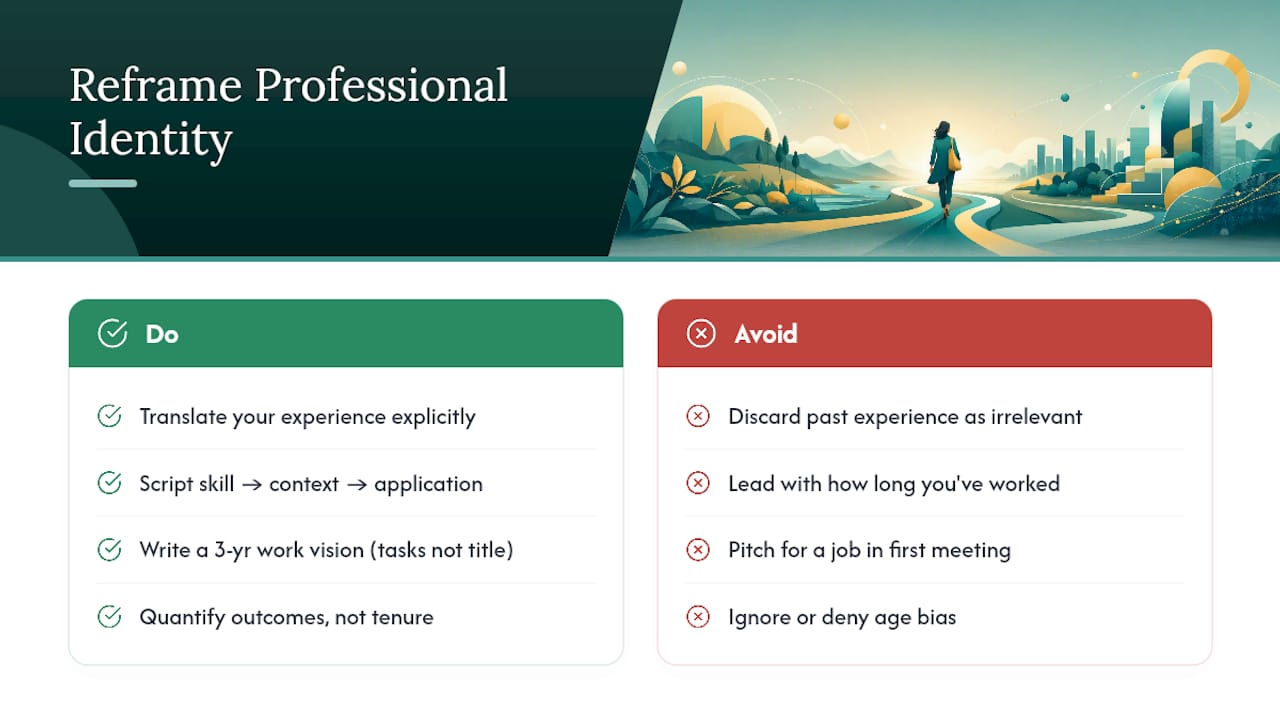
The most useful mental shift is translating your experience rather than discarding it. You're not starting over. You're taking a proven skill set and pointing it at a new problem. A operations manager moving into nonprofit program leadership isn't a beginner, she's someone who already knows how to run a budget and manage a team; she's just applying it somewhere new. Script that translation explicitly for interviews: name the skill, name the context it came from, name how it applies to the new role.
A short exercise helps here: write a one-paragraph vision of your work life three years out, focused on how you want to spend your days, not a job title. Pair it with a quick belief inventory, list the assumptions you're carrying about what you're "supposed" to be doing at this age, and challenge each one directly.
Age bias in hiring is real, and pretending otherwise doesn't help you. The better move is to lead with outcomes, not tenure: quantify what you delivered rather than how long you've been doing it. And treat networking conversations as learning, not pitching. Ask questions, listen for problems you could solve, and let opportunities surface naturally rather than asking for a job in the first meeting.
Pro Tip: In every networking conversation, ask one question you genuinely don't know the answer to. It shifts the exchange from a pitch to a real conversation, and people remember the difference.
How What Next Works Turns Reflection Into An Actual Plan
Most career quizzes hand you a personality label and call it a day. That's not the same as knowing whether a specific pivot makes sense given your actual skills, finances, and constraints. What Next Works was built around the three phases that show up throughout this roadmap: reflection, discovery, and action, structured so each stage produces something concrete instead of another vague insight.
The process starts with a free Career Snapshot, a short self-assessment that maps your accumulated skills and values against realistic next steps, not just a personality type. From there, readers who want a deeper plan can unlock a full Career Roadmap PDF report for a one-time fee of $12.99, no subscription, no recurring charge.
What that report actually contains:
- A career readiness analysis scored against your specific situation
- A satisfaction and independence score breakdown
- A role-family comparison so you're evaluating adjacent options, not just one title
- An employment-versus-independent-work assessment for anyone considering freelancing or founding something
- A job-search funnel analysis plus positioning guidance and a concrete action plan
If you've read this far and you're still not sure whether now is the right time, the fastest way to find out isn't more reading. It's taking the free Career Snapshot and seeing what it tells you about your own readiness.
What I've Learned Watching People Get This Wrong (And Right)
The biggest mistake I see in midlife pivots isn't lack of ambition. It's over-planning paired with under-testing. People spend six months building a spreadsheet of possible careers and zero months actually talking to someone doing the work. Analysis feels productive. It rarely is.
The people who make it through cleanly tend to follow a boring, unglamorous pattern: a handful of coffee chats, one small unpaid project, a certificate that took six weeks instead of two years. One former operations director I've seen described in career-transition writing spent three months just shadowing and interviewing before she ever touched a resume. By the time she applied for anything, she already knew exactly which role family fit and why. She wasn't guessing anymore. She was confirming.
That's the whole game. Stop trying to think your way to certainty. Go gather the evidence instead.
— TK
Ready To Find Your Own Next Move?
Books and quizzes can tell you what personality type you are. They can't tell you whether a specific pivot fits your actual finances, skills, and timeline, which is the gap What Next Works was built to close. Instead of another generic assessment, you get a structured reflection-to-action process that turns 20 years of experience into a clear readiness score and a role-by-role comparison.
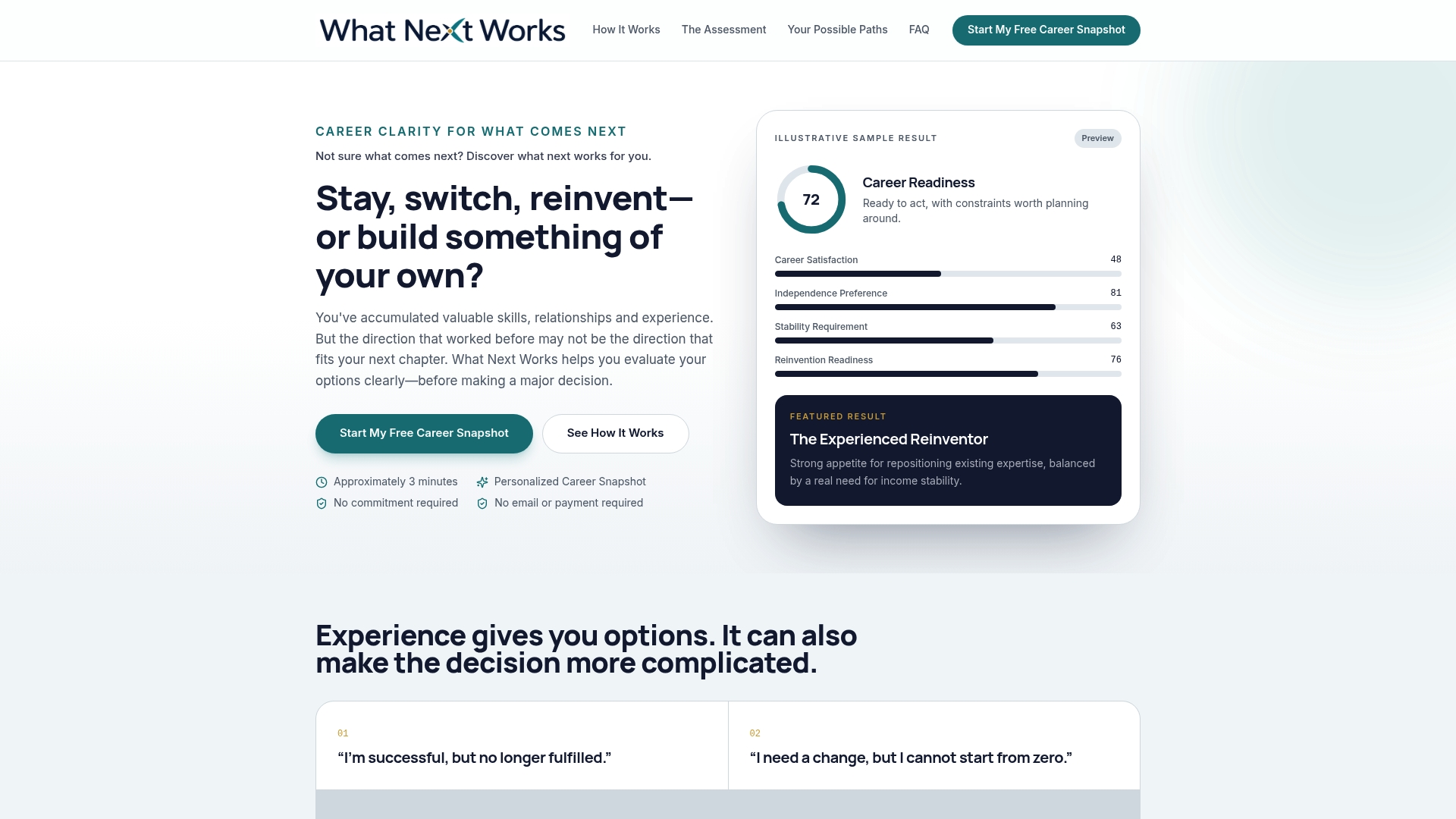
The free Career Snapshot takes a few minutes and gives you an honest read on where you stand right now, no email, no payment required. If you want the deeper version, the $12.99 Career Roadmap report adds a full readiness breakdown, role-family comparisons, and a concrete action plan built around your own answers rather than a generic template. Start with the free assessment today and see exactly where your next move should start.