
A career action plan is a personalized Career Roadmap that turns your last year of work into a sequenced 12 to 24 month plan of experiments, milestones, and decisions. It replaces guesswork with data pulled from what you already did. Start now by taking a free Career Snapshot or committing to a two week test of one option you're curious about.
TL;DR:
- Most people should run parallel discovery and reflection, as early experiments can reshape insights and enhance the overall career pivot process.
- A career plan should be built around three horizons: immediate (0-3 months), mid-term (3-9 months), and strategic (9-24 months), with clear milestones and decision points.
- Testing career options with short, timeboxed experiments like side projects, shadowing, or consulting provides clearer data than prolonged internal deliberation.
- Building a credible private resume involves translating responsibilities into outcomes, outcomes into skills, and choosing options based on skill overlap of 40 to 50 percent.
- Regular review cycles—monthly for experiments, quarterly for scaling or dropping ideas, and yearly for full career audits—are essential to stay aligned with real market signals.
Table of Contents
- What is the reflection, discovery, action framework for a career action plan?
- How do you turn the last 12 months of work into usable career data?
- How do you test career options before committing to one?
- How do you make your experience legible to a new market?
- What does a staged career action plan actually look like?
- How often should you review and revise your career action plan?
- Why the plan matters more than the destination
- Get your Career Roadmap: from free snapshot to a paid action plan
- Sources
What is the reflection, discovery, action framework for a career action plan?
The three steps build on each other, and skipping one is the most common reason a plan stalls. Reflection turns your recent work history into raw material. Discovery tests that material against the real world. Action turns validated signals into a staged roadmap with dates attached.
Each step has a specific output, not just an activity:
- Reflection produces a private resume: a running list of problems you solved, outcomes you drove, and skills you'd repeat regardless of job title.
- Discovery produces market signals: real feedback from small experiments and conversations, not opinions from people who haven't done the work.
- Action produces a staged roadmap: dated milestones across three time horizons, with decision points built in rather than a vague "someday" plan.
Sequence matters more than most people expect. Reflection usually takes two to three weeks of dedicated attention. Discovery runs longest, often six to nine months of parallel experiments while you're still employed. Action starts as soon as one experiment produces a real signal, then loops back to discovery whenever a new option surfaces. A Career Snapshot can seed reflection immediately by scoring your current satisfaction and independence signals, and the paid Career Roadmap picks up where reflection ends, mapping your answers into role-family comparisons and a first draft of the action stages below.
Pro Tip: Don't wait until reflection feels "finished" to start discovery. The two steps work better running in parallel: one conversation this week can reshape what you reflect on next week.
How do you turn the last 12 months of work into usable career data?
Most people's job history is trapped in vague titles and duties. Structured reflection extracts the specifics that actually predict fit for a new direction. Research from Harvard Business School shows that workers who regularly set aside time to reflect on their work see measurable performance gains, and that same discipline works for career direction, not just current-role performance.
Run through these four prompts using only the last 12 months:
- Energized moments. What task or project made you lose track of time, even under pressure?
- Drained moments. What consistently left you exhausted, regardless of how well it went?
- Repeatable wins. What result did you produce more than once, in more than one context?
- Problems solved. What specific problem did people come to you for, unprompted?
From those answers, build private resume fragments: outcome, metric, and the skill behind it, stripped of your job title entirely. A director who "improved cross-team reporting" might really be someone who translates messy data into decisions executives trust, which is a skill that transfers far beyond her current department.
Pull three credible options from the pattern that repeats across your answers, not the one exciting outlier. If the same underlying skill shows up in three different answers, that's your signal, not the job title attached to it.
How do you test career options before committing to one?
Ibarra's action-first research makes a specific point: short, timeboxed experiments generate clearer answers than months of internal deliberation. Waiting for total certainty before testing anything is what career coaches call the readiness trap, and it quietly kills more transitions than any actual market rejection does.
Three experiment types cover most situations:
- A side project (two to four weeks) tests whether you enjoy the work itself, separate from the paycheck attached to it.
- Shadowing (one to three days) tests whether the daily texture of a role matches what you imagined from the outside.
- A short paid consulting sprint (two to six weeks) tests whether someone will actually pay for the skill you think you have.
Set one measurable learning goal per experiment before you start, like "confirm whether I can sell this service to three strangers," not "explore consulting." Then book five to seven informational conversations with people already doing the work, and ask what surprised them in their first year, what they'd tell someone considering it, and what skill gap actually held them back.
Pro Tip: Ask every contact for one specific number, like average project length or typical first-year income. Vague enthusiasm is easy to get; hard numbers are what actually inform a decision.
How do you make your experience legible to a new market?
Titles don't translate across industries; outcomes do. The gap between what you did and how it reads on paper is usually the real obstacle, not a lack of skill.
Build private resume fragments in this order: the problem you solved, the outcome you produced, the repeatable skill behind it, and the context it happened in. That last piece matters because a skill proven in a 500-person company reads differently than the same skill proven at a five-person startup.
Rewrite responsibility language into outcome language:
- "Managed a team of eight" becomes "Grew a stalled team's output by rebuilding how work got assigned."
- "Responsible for client relationships" becomes "Kept three at-risk accounts from churning by rebuilding trust after a service failure."
Research on mid-career pivots points to skill overlap of roughly 40 to 50% between your current work and a target role as the strongest predictor of a smooth transition. Use that number to decide your direction: high overlap favors deepening where you are, moderate overlap favors an adjacent pivot, and low overlap with strong repeatable skills often favors independent work, where you control how the offer is framed.
What does a staged career action plan actually look like?
A workable plan has three horizons, each with its own job to do.
- Immediate (0 to 3 months): Run one to two experiments, build one portfolio piece that proves a skill, and complete three targeted conversations.
- Mid-term (3 to 9 months): Submit real applications or pitches, close specific capability gaps, and land one pilot client or trial project.
- Strategic (9 to 24 months): Hit your decision point on staying, pivoting, or going independent, set an income target, and scale whatever worked.
Editorial frameworks built around monthly themes work well here because they keep momentum steady. The failure modes sit at both extremes: over-preparing for a year with zero market tests, or quitting a stable role before a single experiment confirms demand.
How often should you review and revise your career action plan?
A plan that never gets checked against reality just becomes a wish list. Build in three review rhythms, each catching a different kind of drift.
- Monthly: track what each experiment taught you, how many new people you talked to, and what specific feedback you got from interviews or pitches.
- Quarterly: decide whether to scale an experiment that's showing traction or kill one that isn't, based on the actual data, not sunk cost.
- Annually: run a full career audit, refreshing your private resume, auditing which relationships are still active, and reassessing how automation or AI is reshaping your field.
Forbes recommends firing yourself once a year as a deliberate exercise: pretend your role just disappeared, then ask what you'd need to be ready. Workers who build in dedicated reflection time this way report performance gains in the range of roughly 18 to 22.8% compared with those who never pause to review.
Why the plan matters more than the destination
Most career advice sells certainty: find your passion, then the path follows. That's backwards. The professionals who move well are the ones who test cheaply and often, then let the evidence pick the direction. Structured reflection tools work best paired with prompts or a trusted second opinion, which is exactly why a solo journal rarely produces the clarity a guided process does.
The real risk at this stage of a career isn't picking the wrong direction. It's spending eighteen months preparing for a decision you could have tested in six weeks. Start one small experiment this month, or take a free Career Snapshot to see where your own data points.
— TK
Get your Career Roadmap: from free snapshot to a paid action plan
Whatnextworks turns the framework above into an actual document instead of a mental exercise you never finish. The free Career Snapshot takes 10 to 15 minutes and returns your initial satisfaction and independence scores, the raw data that seeds your reflection step and points you toward which experiments to run first.
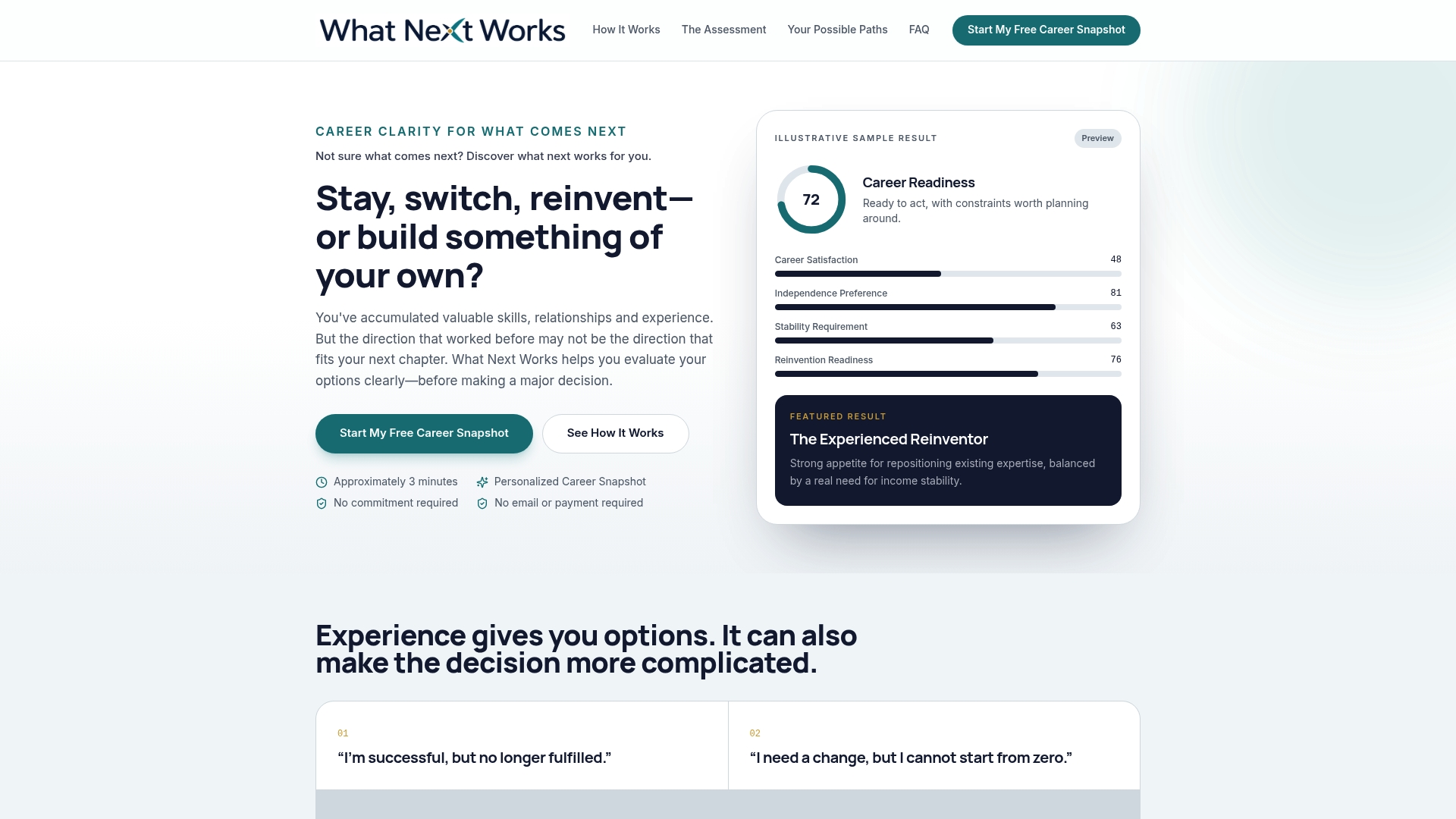
From there, the paid Career Roadmap builds directly on your Snapshot answers: a full readiness analysis, a role-family comparison so you can see how your skills stack up against adjacent paths, an employment-versus-independent-work breakdown, and a staged action plan with decision dashboards mapped to the immediate, mid-term, and strategic horizons covered here. Instead of guessing which of your three candidate options deserves a real experiment, you get a document that ranks them against your own data. Take the Snapshot first, review your results, then decide if the full Roadmap is worth the $12.99 to turn your next 24 months into a plan instead of a question mark.
Sources
This guide draws on Harvard Business School's reflection research, the University of Michigan's review of reflection tools, and Forbes coverage of mid-career pivots and annual career audits, alongside the Whatnextworks framework itself.
- Reflecting on work improves job performance (Harvard Business School Working Knowledge)
- Review of reflection and distancing tools (Annual Review / University of Michigan-hosted PDF)
- The Mid-Career Change Most People Consider And Almost Nobody Make (Forbes)
Recommended
Made with BabyLoveGrowth to get found on Google and AI search